Thursday, February 12, 2015

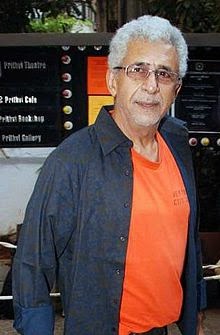
And Then One Day: A Memoir -- Naseeruddin Shah


Irreverent, witty, nonchalant, breezy and yet profound. That’s Shah’s book in short. Coming after Dilip Kumar’s underwhelming work, this was a sparkler.

Be it his taut relationship with his father, or his bizarre first marriage, Shah spares few. Where he does let readers down is when the few he spares are mostly the Bollywood biggies (It’s not AB, if that’s what you are thinking, though there’s not much about him either). 

Shah is arrogant and knows it. He is judgmental and shows it. And boy he can write, and proves it.
Anyone who disagrees with his views is free to write a ‘counter’ book. Till then, this one will remain a benchmark for Bollywood icons.

The short epilogue of the book is one of the best I have ever come across till date. Consider this:
“Ever since I was fifteen years old, following my triumphant turns as Shylock and Lear in school, when I actually began to dare to think of myself as an actor I have always had this waking nightmare: one day I meet up with a wise old man who, after watching my work, says to me, ‘Well… doubtless everyone has always said you are a very good actor but…’ And I still have no clue what he says after the ‘but’…

I think I have reached the stage that when I look in the mirror I get a hazy glimpse of him and he’s looking right into my eyes.”

Take a bow Ramchandra Guha for goading the man into completing the work.

Wednesday, January 21, 2015

An old friend swims away

The wobbly jamboree swarmed in to nibble at anything that was dropped into the algae-laden water. Anything. Pebbles, dead insects, leaves. Even spit. Particularly spit. Our mucus was their favourite.  

Within weeks of the first showers, they were omniscient like the moisture, like the blood-red kunnikkuru – millions of Cadbury Gems-like seeds scattered across the landscape.

She and her friends appeared out of nowhere even as the intense monsoon air cafuned me, when the fine, incessant drizzle played mist in my part of the world. Hitherto dead and muddy water bodies sprang forth with life every June. And when the ponds and canals filled up, she would slip into the ancient lanes and pebbled paths with the gurgling overflow.

For years we were companions. Many were the damp, lazy afternoons of my boyhood and teens 
when I watched over her, tried to hold her, as she frolicked without a care.

We never got introduced though.

Not when I sneaked out of home with twine, hook and earthworms dug up from the backyard of my elderly abode, just to meet her. Not when a cousin named her Thuppaloothi – broadly, spit-eater – for me, just to avoid elaborate explanations. Not when my friends called her Sooli. Not even when she was the star resident of my aquarium.  

Yes, I was in love with her. How could I not be? Pale ochre, with an unmistakable black and red strips
running across her lithe body. For a long time I was convinced that the ethereal one had descended from the skies with the rains. Just like the abrupt profusion of foliage – the medicinal communist paccha, the leathery and ferocious-looking chena-ila, the shy thottaavaadi and the sensuous thumba.

So enamoured was I that once, asked to buy sugar from the corner grocer for the evening tea, I spent three hours leching at her. Indeed, I almost had her in my palms that day, only to be startled by my furious grandpa’s booming voice and that ominous cane.

Thuppaloothi was never alone. The Kannanchaathan was a loner. But he was the smartest too. He would jump out of the water and land at another spot, leaving predators baffled. Paddy fields and temple ponds were home to a variety of Parals and Blaappys. Packs of catfish – Muzhu, Kadu and Etta – were the most slippery, with slithering bodies and stings.
 
Schools of goldfish-like tiny ones indicated the presence of the mighty mother Vraal right underneath. She was the bigger boys’ favourite catch.

As others of my age dived from ever higher jackfruit branches, their fall broken by climbers and creepers, for me, it was the smaller drains and tanks. ‘What lies beneath’ held the allure for me. I felt lifting that veil of mystery by going underwater would spoil it. Truth be told, I was just pathologically scared of chest-deep waters.

Often I would be dipping my palms into the very gutter that would have someone peeing into it just a few metres away. Let’s believe the water flowed in the direction that left no disgust.
 
But that was my world. My own world. Of Kumblakottans, cuckoos, cashew apples and bicycles hired for Rs 2 an hour.

Today, the neighbourhood pond lies unused and lifeless. Bathrooms are the new attorneys of modesty. No more careless frolicking – neither us, nor her.
Many of her companions vanishing, Thuppaloothi too seems to be in her last lap.

A few years back, when she was tagged on the IUCN Red List of Threatened Species, I finally got her name. Denison’s Barb, the freshwater fish species, is among the biggest conservation challenges of the Western Ghats.

They tell me the mistiming monsoon still brings down its version of the mist on the undulating landscapes of my hiraeth. But it misses its progeny.

A monsoon sad and lonely.
 
Thuppaloothi
Born: In my boyhood
Died: Before I do


Tuesday, January 20, 2015

Dilip Kumar: Missed Opportunity


Dilip Kumar’s “The Substance And The Shadow: An Autobiographyis underwhelming.

He may be a great actor. But the book is plain boring. It may be either due to his advanced age, wherein he couldn’t recall much. However, I suspect he chose to keep it that way. It is a please-all venture with major lacunae, bad proof-reading and certainly conceited in parts.

The discontinuity in the narrative is palpable and some of the most important parts of the 92-year-old icon’s life are missing. Even where he chooses to reveal uncomfortable episodes, he keeps them obscure and confusing, maintaining a facade of decency.

The man obviously takes immense pride in his being a virile Pathan -- a package that supposedly comes with in-built dignity, machismo, fearlessness and good looks, besides of course the inescapable sense of honour. Yusufsaab almost has a fetish for his “manhood” (he just can’t stop describing his body hair).

However, his Pathan self-image comes across as jarring when he passes unguarded comments on other communities, be it Bengalis, Tamilians or the British.

The biggest gap in the book involves some of the giants of the era completely missing from his narrative. The third pillar of the matinee triumvirate, Dev Anand, has little more than a mention here and a picture there. The singing icons Mohammed Rafi, Talat Mehmood and Mukesh, who played a humongous role in Yusufsaab’s popularity are not even named.

He makes no comment on the period and upheaval of the partition, despite the fact that he paints an extensive picture of his hometown Peshawar, where he spent his childhood. Important characters in his early life – his grandmother, his home – disappear mid-way.

No mention of the bloody riots that plagued Mumbai at the time he was already a rising star. No insights on what post-partition India felt like for Muslims with roots in Pakistan.

However, there are some three chapters on one topic – his wife, Saira Banu. He is clearly enamoured. Beyond a point it becomes outright boring.

The second part of the book has a series of write-ups about him by famous personalities and others close to him. They all sound the same – like the Gandhi family ‘yes-men’. Can’t blame them; after all, they can’t be critical of him in his own autobiography, can they? 

There's so much more one would expect out of an autobiography of India's premier movie legend. What a wasted opportunity.

Monday, December 29, 2014

PK: by Rajkumar Hirani


PK, along with Oh My God!, marks the coming of age of mainstream Bollywood as far as religion is concerned. Finally they catch up with regional cinema -- I can speak for at least Tamizh and Malayalam -- in branding the conventional understanding of religion as a whole stinking pile of bullshit.

If I am not mistaken, Tamizh cinema in the 60s and 70s and Malayalam beginning in the 80s have been consistently trashing religion -- even while they glorified it at the other end.

This courage to call a spade a spade is welcome, to put it very mildly.

PK is convoluted in parts. It has all the silly preachiness of a typical Aamir Khan movie. It has ridiculous romance injected into it. And Aamir, of course, will never be able to act in this lifetime. (All credit to him for showing the guts to play protagonist though)

But Rajkumar Hirani and his dialogue-writer deliver. Each line is a tight slap on the face of the swam-padre-mullah brigade. Each question a tight slap on the face of "their" god. Each example a complete stripping of the temple-hopper.

Wine in a mosque. Puja ki thaali in a church. Frauds in a temple.

This is just the dose of medicine this stupid religion-crazy nation needed at this time of the year.
Just don't miss it. Especially if you are the god-fearing kinds!

Sunday, December 14, 2014

Hark, O Hindu-Indian!

Branding non-Hindus as non-Indians is the cornerstone of India’s hindu-isation. For the quintessential Sangh proponent, “haramzaada-ization” of the other is an article of faith.

Some, like M S Golwalkar, Subramanian Swamy and the PM’s sadhvi-sant footsoldiers, are repulsively honest about it. BJP chief Amit Shah, his master and other more evolved saffron merry men, who have a lot to lose by publicly embracing the diabolical intent, prefer the dogwhistle.  

Yet another set has for years desperately tried to intellectualise the project. Their written and verbal arguments are the Trojan Horse that let the most virulent of agendas seep into public mindspace without evoking conscious resistance.

Consider the affable Swapan Dasgputa’s column this week in The Sunday Times of India. In “How do losers remember the past? A lesson from Germany”, Dasgupta apparently tries to draw parallels between a defeated post-World War-I Germany and India.

Somewhere midway in the piece, after rambling self-servingly about his “high-table” outings, the Hindutva ideologue slips this in: “For too long – indeed, till the victory in the 1971 war – Indians have invariably been on the losing side in conflicts. There has been the odd occasion when a Maharana Pratap, a Lachchit Borpukan and a Shivaji momentarily turned the tables against superior foes.”

This is the crux around which he weaves a verbal miasma. In one broad stroke, Dasgupta brands as "non-Indians" Akbar and Aurangzeb -- two Muslim emperors of vastly different worldviews, notwithstanding the fact that they were as Indian as the Taj Mahal and the Red Fort.

(Somebody ask Dasgupta if the Hindu Ramsingh who fought Borpukan on behalf of Aurangzeb was "Indian" or "non-Indian")

Using Dasgupta’s yardstick, one could brand the Jain-Hindu Kalinga kings “Indian” and Hindu-Buddhist Emperor Ashok “non-Indian”. Similarly, Rudradaman-I -- a century 2nd century Saka/Scythian king tracing his roots to central Asia – would be a “foreigner”. The Telugu-speaking Hindu Satavahanas, whom Rudradaman defeated, were Indian. Were the south Indian Jain-Hindu Pallavas (Parthian-Persian-Parsi-Pahlavi) “non-Indian” and their arch rivals, the Kannada-speaking Jain-Hindu Chalukyas, “Indian”?

It could go on till, ridiculously, even a certain Sakyamuni (Scythian sage) Siddhartha Gautama is deemed “non-Indian” – both in terms of ethnicity as well as religion – by the esteemed journalist.

However, going by Dasgupta’s well-known inclinations, he is obviously referring to only Muslim “non-Indians”. So his call is to the psychologically “defeated” Hindus to get over the “loserly” attitude and get back to “winning ways” – all wrapped in benign insipidity.  

Bite that, O Hindu-Indian!

Thursday, December 11, 2014

Godse indeed was a nationalist!

Sakshi Maharaj is right, Godse was not an anti-national!

Chaddiwala MP Sakshi Maharaj may not have realized the profundity of the partial truth in his statement. This is what PTI quotes Maharaj as saying: “He (Godse) may have done something by mistake but was no anti-national.”

Even accounting for the continuing attempts to rehabilitate Godse – and with him, chadditva itself – among mainstream Indians, Maharaj’s stand that Godse was no anti-national is an undeniable truth. Godse was a nationalist.

In fact, that was the problem; that he was a nationalist. Like all nationalists – including Godse’s ideological progeny who run this country today -- his sense of identity was etched in black and white. There was no place in it for “the other”.

Nationalism disallows or refuses to recognize shades of grey, fringe areas and multiple identities. You got to pick and choose and stick to one no matter what your persuasion or attitudinal intensity is towards that chosen identity.

Ironically, Godse, brought up as a girl by his parents, grappled with a deep identity crisis himself. And he thought Gandhi’s philosophy would render India effete. That’s some kind of projection, an amateur psychoanalyst would assume.

So, while for public consumption feku sings paeans to Gandhi, giving his busts a fresh coat of saffron paint, feku’s merry men continue overtly and covertly to crusade against an allegedly “effete” Bharat mata born out of Gandhi’s worldview.

Bhakts -- including the neoconverts -- either don't understand this or they pretend not to.

Thursday, November 13, 2014

Rescuing Ram


"How did my father, the king of Mithila and the lord of the Videha, get you, a woman disguised as a man, for a son-in-law?"
-- Sita asking Ram (Ayodhya kand, Valmiki Ramayan)

Dattaram Chiplunkar is not the overtly religious type. But even at 52, as at 10, the revered Gayatri mantra ushers in his day. While Dattaram has never read the complete Ramayan, he, like millions of others, never really got over its first narration. This government bank employee was, of course, one among the millions who scheduled their Sunday morning activities in the late 1980s according to Ramanand Sagar’s TV adaptation of the epic.

Dattaram is incredulous when told that at one point in the Valmiki Ramayan, Sita suspects Ram of sliding into “cruelty without a justified cause for hostility” – a somewhat Lawrence of Arabia-ish quirk – and she even gently chides him for that. 

“I thought Ram was always in control of his senses. He was the ultimate leader,” says this father of two, not knowing that on several occasions in the tale as per Valmiki, Ram exhibits weakness, requiring Lakshman, Sugriv or others to prop up his spirits. 

With Indologist Wendy Doniger’s book “The Hindus – An Alternative Narrative” once again bringing to start relief the hyper-sensitivities in India over religion, it would be ironic to state that leave alone alternative narratives, even mainstream or “original” texts are not really read or understood by the country’s masses.  

Krishna Raj, a senior research executive with Nerolac Paints, sounds surprised when told that some major female mythological characters such as Sita, Draupadi and Satyavati had their breasts and other private body parts, frequently likened amorously to fruits, elephant trunks and plantain.

“I must have heard the Ramayan when I was around six. Though I have been enamoured by it, I never ventured to read and explore any of the versions,” says the 40-year-old.

For Renuka Murthy, a Chennai housewife, Amar Chitra Katha’s depiction of the tale is the Ramayan. So is the similar version of Mahabharat – “simple and captivating”.

Thence lies a lacuna between the popular narratives of our epics and mythology and their various original versions. Is this rendering the splendours of our ancient legends and heroes into caricatures? Is this veritable disconnect in perspectives distilling their myriad nuances into Bollywoodish bipolarities of good and bad?

Besides bed-time stories, mass media and school text-books, the Ramayan’s nobility, Mahabharat’s varied philosophies and Puranas’ symbolism percolate into the average Indian through osmosis with his or her immediate environment. For, there is rarely anything about mundane life in this country that doesn’t resonate with some trickle of its mythology.

However, most of us, at least in urban India, are content with the stock mental imagery that’s a part of popular depiction. More worrisome: Even tangential attempts to change set notions are fraught.

According to mythologist Devdutt Pattnaik, 80-90% of Indians get their first taste of the Ramayan orally and not through texts. Of the rest, he says, 50% are in the regional languages. Perhaps only 5-10% would be familiar with the Valmiki Ramayan, considered one of the earliest and, for many, perhaps the “original”.

“Ramayan is not a text. It is a parampara (tradition). Most of us have not ‘read’ the text version of the Ramayan. We have only ‘heard’ it. But it more or less ends there,” says Pattnaik, author of such mythology-based books as Jaya, An Illustrated Retelling Of The Mahabharata and The Book Of Ram. “There is a lot of self-consciousness involved in poplar narratives. There is a clear attempt to make the Ramayan politically palatable,” he says.

Suggestive interpretations of the epic may be kosher in private conversations, but public portrayal may lead to much more than just a few raised eyebrows, Pattnaik feels. Notwithstanding the fact that the Ramayan is a beehive of such surprises.

Take Ram, that enduring symbol of human ideal, for instance. For all the emphasis on his human birth, many of us would loathe to acknowledge the associated frailties, the very traits that make him the central character of the epic.

The fact that he hopelessly breaks down frequently when distressed and needs constant ‘pushing’ by either Lakshman, Sugriv or others, rarely informs our idea of Ayodhya’s eldest prince. Sita’s acerbic barbs at him, perhaps just what today’s feminists may be looking for, jar when superimposed on our received notions of the demure princess.

“The layman doesn’t want his set of ideas tampered with. Only some, who go slightly deeper, develop a more clear and critical attitude,” says Dr Bodhisattva, a scholar of Hindi and an expert in traditional Indian texts, who also works closely with the television media, offering ideas and perspectives.

“What most of us come across in the name of mythology is the culturally edited version. I believe such editing of texts meant for adult consumption is anti-social and anti-tradition,” Dr Bodhisattva says.

Texts like Ramayan and Mahabharat are important because they determine our attitudes towards a variety of things, from social mores to family to politics. That makes it even more important for them to be understood in all their glorious shades of grey.

Take social hierarchy for instance. One scholar cites the Ekalavya episode of the Mahabharat. The immensely talented tribesman approaches Dronacharya to be taught, only to be refused. The guru’s reasoning is subtle: Ekalavya is not the ‘son of a prince’. Now, that is different from Ekalavya being declared ineligible because he belongs to what, in our milieu, is a Scheduled Tribe. However, the latter is invariably what we have internalized.   

To be fair, the Amar Chitra Kathas and the Ramanand Sagars must be credited with initiating and popularizing the epics, even if they failed to dwell deeper. After all there are various considerations, including sensitivities and market dynamics involved. 

“Most importantly,” says Pattnaik, “they were also a product of a need to accommodate mindsets informed by western idioms and ideas of morality and modesty.” Focus on nuances, he says, could only distort the existing idealistic image of our heroes. This, however, reinforced existing notions, depriving us of profound and meatier aspects. Tragic.

According to economist Bibek Debroy of the Centre for Policy Research, New Delhi, unabridged original versions must be disseminated through popular media. Debroy, currently translating the entire Mahabharat into a 10-volume Penguin publication, would know. For, he admits “suppressing” episodes involving the graphic description of Siva’s sexual escapades when he translated the Puranas long time back.

“Today I am a little more matured. I wouldn’t edit them out,” Debroy says, adding, “I suspect public reaction to unabridged versions would depend on the character involved. If it is Ram or Sita, all hell could break loose. But if it is Krishna, tolerance would perhaps be higher.”

Translators would face issues in other contentious areas too, such as meat eating and treatment of liquor. Pattnaik says he came across a version of the Ramayan in Dantewada, which, if narrated publicly in mainstream society, would lead to the narrator getting butchered! Dr Bodhisattva too feels audiences will accept culturally unedited versions of mythology if they are not manipulative.

“My elders used to read the Adhyatmaramayanam (by the 16th century Malayalam poet). I myself started with C Rajagopalachari’s version. Now I regularly listen to expositions on the epic on TV. I now realize there is so much to be discovered, spiritually and otherwise,” says Ramakumar Menon, a senior official with a government petroleum company.

“Mindsets are changing with time. There are so many things in the texts, which may come across as surprising to us. Yet, with today’s media being increasingly transparent and explicit, I feel it should lead to better appreciation of our epics,” said the 57-year-old Menon.

Authentic portrayal could fill up the perspective gaps, often exploited to engineer social upheavals based on mythology. Besides, that could also slam the brakes on a plausible vicious cycle of conservatism distilling mythology into undimensional popular narratives and this, in turn, feeding more conservatism.  

There is a goldmine of ideas, which capture the spirit of India in all its glory, idiosyncrasy, melodrama and delight, lying buried under the debris of convenient hand-me-downs.

An entire pantheon awaits redemption.